
If money talks tend to spiral into tension, you are not alone. Research from the American Psychological Association shows that money remains a leading source of stress for Americans, and that pressure often shows up most at home. Budgeting apps for couples give you a shared system, a neutral source of truth, and simple habits that transform anxiety into alignment.

Why couples argue about money (and how apps help)
Money conflict usually is not about math. It is about mismatched expectations and unclear roles. Common friction points include different spending styles, invisible mental load for bills, lumpy income or irregular expenses, debt payoff timing, and uncertainty about what is actually affordable.
A shared budgeting app solves for visibility and timing. Automatic transaction tracking, alerts before bills are due, and a clear plan for monthly categories reduce surprises. The best apps also give each partner the same dashboard, so decisions are based on the same data, not memory or assumptions. For context on stress trends, the American Psychological Association provides an overview of financial stress on its topic page, which is a helpful reference when setting shared expectations about money conversations. APA, Stress and financial pressure.
What to look for in budgeting apps for couples
Choosing the right tool is half the battle. Use this checklist as you evaluate budgeting apps for couples.
Shared visibility without spreadsheets
Both partners should see balances, recent transactions, and upcoming bills from all connected accounts in one place. This reduces “Have you paid this?” and “Can we afford that?” debates.
Automatic expense tracking and categories
Apps that connect to your banks and cards and categorize transactions minimize manual entry. Look for easy recategorization and rules to keep future transactions consistent.
Budgeting that fits how you live
You want flexible categories, envelope or zero-based styles if desired, and the ability to roll over unspent amounts. Couples benefit from category notes and tags for clarity.
Bill and debt tracking
Due-date calendars and reminders prevent late fees. Debt tracking and payoff progress keep motivation high, especially when you are using methods like the avalanche or snowball.
Alerts that prevent surprises
Customizable notifications for low balances, big purchases, or budget thresholds let you course-correct in real time. They also create gentle prompts for quick check-ins.
Account reconciliation and reporting
Reconciliation makes sure your records match the bank. Monthly and year-to-date reports turn raw spending into insight, which supports calm, factual money talks.
Credit score and investment visibility
A snapshot of credit health and investments keeps long-term goals, like buying a home or retirement, part of your regular conversations.
Security and shared access options
Look for reputable connectivity to financial institutions, the ability to manage notifications for both partners, and clear privacy controls.
Couples feature guide at a glance
| Feature | Why it matters for couples | What good looks like |
|---|---|---|
| Shared dashboard | Eliminates he-said/she-said and guesswork | Both partners can view budgets, bills, and balances across accounts |
| Automated tracking | Reduces manual work and missed transactions | Reliable institution connections, quick categorization, easy rules |
| Budget customization | Aligns the plan with your real life | Flexible categories, rollovers, goals by category |
| Bill and debt tracking | Prevents late fees and keeps payoff momentum | Due-date calendar, reminders, debt payoff progress |
| Alerts and insights | Nips issues early, reduces stress | Low balance alerts, unusual spend alerts, budget threshold alerts |
| Reconciliation and reports | Builds trust in the numbers | One-click reconcile, monthly trend and category reports |
| Credit and investments | Keeps long-term goals visible | Credit score monitoring and investment tracking in one view |
A simple 30-minute setup for two using MoneyPatrol
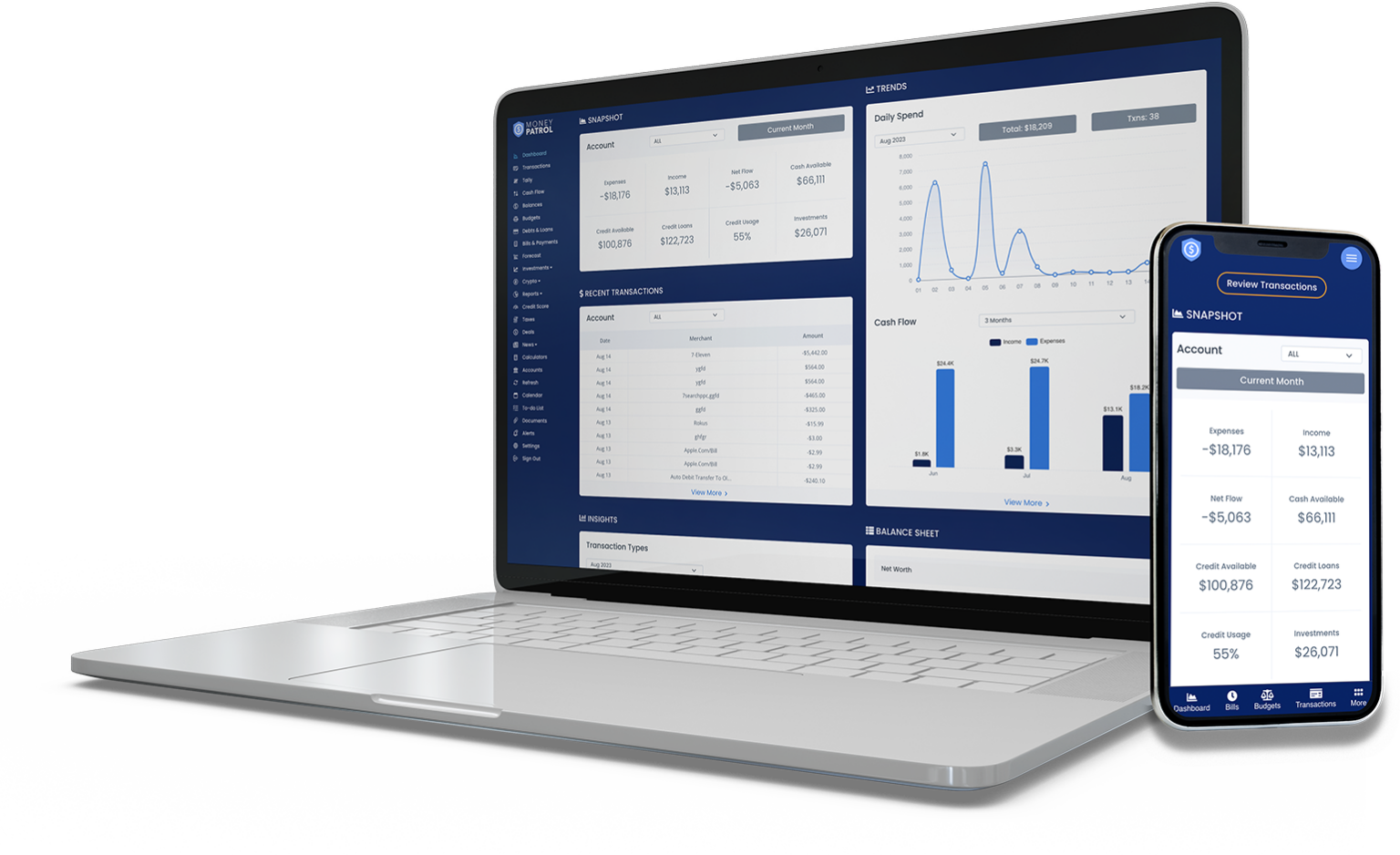
MoneyPatrol is a free, comprehensive personal finance and budgeting app built to help you track expenses, manage income, monitor accounts, and hit goals together. It brings expenses, budgets, bills, debt, investments, and credit score into one dashboard with customizable alerts and detailed reports. Here is a quick-start routine you can complete in half an hour.
- Define one shared goal for the next 90 days: For example, build a 1,000 dollar emergency buffer or pay 500 dollars toward a specific debt.
- Connect your accounts to MoneyPatrol: Link checking, savings, credit cards, and loans so both partners see the full picture in the personal finance dashboard.
- Create 8 to 12 core categories: Keep it simple, think housing, groceries, dining, transportation, subscriptions, health, fun, savings, and debt.
- Set monthly budget amounts together: Use last month’s actuals as a starting point, then adjust to align with your 90-day goal.
- Add bills and due dates: Turn on reminders for both of you so no one is the bottleneck and late fees stay at zero.
- Turn on key alerts: Enable low-balance alerts, large-transaction alerts, and category threshold alerts for shared awareness.
- Schedule a 15-minute weekly money date: Review new transactions, recategorize if needed, check your bill calendar, and celebrate one small win.
Build communication guardrails that keep the peace
Money dates work best with ground rules that make conversations safe and quick.
- Speak in observations, not accusations, for example, “We are 40 dollars over in dining, what do we adjust?”
- Use a purchase threshold rule, for instance, “Text each other before any unplanned spend over 150 dollars.”
- Decide who does what, for example, one partner reconciles weekly, the other manages bill reminders.
- Document decisions inside category notes to avoid rehashing the same debate next week.
Automation is your stress reducer
The less you track by hand, the more consistent you will be. Automatic imports, categorization rules, and alerts do the heavy lifting for couples. Businesses lean on automation to reduce errors and manual work too, a useful analogy when you think about your household routines. If you are curious about what this looks like at an organizational level, you can skim how AI automation platforms for businesses streamline repetitive tasks and keep teams focused. The principle is the same at home, let the system do the grunt work so you can focus on decisions and goals.
Security and privacy for two
- Use strong, unique passwords and turn on multi-factor authentication where available.
- Keep both partners’ contact info up to date so alerts and reminders reach the right person.
- Review an app’s data and privacy disclosures before connecting accounts, understand what is stored and how it is used.
- Reconcile regularly so you spot errors or fraud quickly and can act fast with your bank.
Common pitfalls and easy fixes
- Too many categories, simplify to the handful that drive decisions and set the rest as occasional.
- Inconsistent check-ins, put a recurring 15-minute money date on the calendar and keep it short.
- No buffer for irregulars, create a sinking fund category for annual expenses like insurance or holidays.
- One person owns everything, split tasks and rotate occasionally so both partners stay engaged.
How MoneyPatrol supports couples
MoneyPatrol brings both partners onto the same page with a single, organized view of your financial life. It tracks expenses automatically, supports straightforward budgeting, and keeps your bill calendar, debt payoff, and savings goals visible. You get customizable alerts, account reconciliation, and detailed reports to turn conversations into action. The app also tracks investments and monitors your credit score, which helps couples plan for milestones like a new home or a car upgrade.
Because MoneyPatrol is free and connects to thousands of financial institutions, it lowers the barrier to getting started. Whether you are merging finances completely or just coordinating shared bills, it gives you a practical, low-friction system you can use together right away.
Frequently asked questions
Should couples combine all accounts or just share a budget? Both approaches can work. If you prefer autonomy, keep individual accounts and create a shared budget for joint categories like rent, groceries, and utilities. Review your shared dashboard weekly so the plan stays aligned.
How do we budget with uneven incomes? Base your shared budget on the lower, stable income, then treat the variable or higher income as a buffer for savings, debt payoff, and irregular expenses. This keeps core bills covered even in lean months.
What if one of us hates budgeting? Reduce the friction, keep categories simple, automate imports and alerts, and limit meetings to 15 minutes. Let reports do the talking so the conversation is about trade-offs, not judgment.
How do we handle cash and peer-to-peer payments? Create a small cash category and enter occasional cash spends during your weekly check-in. For P2P apps, add quick notes like “rent split” to transactions so categories stay clear.
Can we track debt payoff and credit health together? Yes. Use the debt tracking view to monitor balances and progress, and review your credit score snapshot monthly. Put a reminder in your calendar to celebrate each milestone.
What is the right alert setup for couples? Start with low-balance alerts on your main checking account, large-transaction alerts, and category threshold alerts for groceries and dining. Adjust after the first month based on what actually helps.
Start your next money conversation with clarity
If you want less stress and more teamwork, give yourselves the gift of a shared system. Create your free account and set up your first couples budget with MoneyPatrol today. It takes minutes to connect accounts and start tracking together, and the payoff in calm and confidence starts right away. Get started at MoneyPatrol.



 Our users have reported an average of $5K+ positive impact on their personal finances